Friday, 13 May 2011

Sapa, A Wedding in the Clouds, 8-12 March 2011

The sound of the train slowly chugging out of Hanoi somewhat tiny and lo-tech train station immediately relaxes me and memories of Russia comes flooding back. I was lying on my top bunk in a rather plush cabin with three other people, one American girl, Jayne, who had been staying in my hotel, an Australian man from Darwin and his Vietnamese 'wife'. I had bought my ticket from my hotel and they had booked me a first class ticket for $27 which is quite expensive in Vietnamese terms but the air conditioned cabin proved that it was worth it.

The rail system in Vietnam is relatively new and is commonly referred to as the Reunification Express as it links North and South Vietnam together. There is only one line which runs from Loa Cai in North West on Chinese border, to Hanoi and then down to Ho Chi Minh City in the far South. I was on the night train to Loa Cai where I was going get off and onto a bus up the hills to Sapa.

The journey was bumpy, slow and I couldn't see anything out of the window as the dark had swallowed all of the landscape. The other three in my cabin soon wanted to go to bed, so the lights were switched off and I retired to my bed where I watched several episodes of 24 on my MP3 player. Although the bed was comfortable and the temperature was bearable, sleep was near enough impossible as I was constantly being bombarded with a freezing blast of cold air from the air-conditioning unit on the ceiling. I tried changing positions but it didn't help, I then tried to stuff my shirt in the vent to no avail.

The train pulled up in Lao Cai railway station around 6.30am and we dragged our bags from the carriage onto the platform and into the barrage of waiting drivers begging for our custom. I hadn't booked my onward bus ticket to Sapa, which was an hours drive up into the mountains. The others in my cabin had already got tickets, so I decided to go along with Jayne and see if there was a spare seat for me in the bus. I struck lucky as I was welcomed on the bus and was soon on the ascent up the hills.

Sapa is a quiet small village sitting 1600m up in the mountainous north-east close to Mount Fansipan which is the highest peak in Vietnam at 3142m. It's famous for it's stunning scenes of the amazing rice terraces that spread out below the village and the ethnic people of Hmong, Dao, Tay and Giay tribes. The drive up through the mountains could be a fantastic experience, especially as the sun was rising over the rices terraces and mountain peaks but this morning, all I saw was mist. There were certain brief moments where the mist cleared and exposed the dramatically beautiful landscape stretching out below us before engulfing us again and diminishing the visibility down to just a few feet all around us.

As we arrived high above the mountain, I suddenly felt the cool mountainous breeze chill my bones to the core and I dived into my backpack to retrieve my fleece that I hadn't worn since China. With my fleece on and my bag on my shoulders I headed off to find the Green Valley International Youth Hostel. I had no idea where it was and when I asked the bus driver, he turned away, grabbed two Hmong girls and told me to follow them. This frustrated me a little as I knew they just wanted money from me. Despite that, I went with them and followed them down the road that led out of town, I couldn't see anything further than 5 meters in front or behind me. As we walked, we went through the usual questions of 'what's your name?', 'where are you from?', 'how old are you?' and I discovered that the two girls, Mai and Chuin were both Hmong girls, aged 14 and lived in Lai Chai, the neighbouring village. They come up into Sapa to sell their goods everyday to tourists and also acted as guides, taking people into the surrounding area. Today they were my guides, taking me to my hotel where I seriously needed to get some rest. I got there and said goodbye to Mai and Chuin whilst refusing to buy any of their wares but promising that if I were to buy something, I would buy it off them. I then sunk my head into the pillow on my bed in a rather cold room for a couple hours sleep, to my surprise, the bed came with an electric blanket which, once under the duvet, kept me at a nice comfortable temperature which helped me fall into a deep, overdue sleep.

A week before my trip to Sapa, I sat in a restaurant in Hanoi with Keith who had told me about his time in Sapa and how it was freezing cold and the weather was abysmal. I thought he was exaggerating as he had just been in Cambodia for a long time and travelled northward but I now realised that he was telling the absolute truth and I was shocked that I had to delve deeper into my bag and find my thermal vest as it was so cold. The cloud didn't lift for three days and remained constantly wet. Walking around a town that you did not know in extremely poor visibility is not the easiest thing to do as I couldn't see ten feet in front of me let alone any landmarks to orientate myself from. There was one point in the main square, I was standing amongst the ethnic market in the middle but couldn't see the sides of the square that ascended above.

After my first day was over, I thought I should head into the centre of town and find a restaurant to eat dinner in as the hostel was dead but on my way out, the owner of the hostel collared me and invited me to eat dinner with his family. It was a lovely surprise and a very welcome invitation, so I kindly accepted and joined then in the restaurant for dinner. There was a group of eight around the table digging into the delicious spring rolls, rice, meat and various noodles that the grandmother and the true boss of the family had prepared earlier. The only other guest staying in the hotel was a German man who sat next to me, whose name was as much of a mystery to me then as it is now, was cycling around the world bit by bit, this trip he was going to do from Hong Kong down to Saigon but unfortunately the weather had conspired against him. He told me as we ate that he had been waiting in Sapa for a week to get a decent spell of weather for his onward journey down the mountain towards Hanoi. However, he had only experienced one sunny day, the day before I arrived, and he used that to go for a trek around Sapa. My hopes for seeing good weather were dramatically low. We finished the evening off by playing a pool competition whist drinking extremely potent rice wine that the boss' brother had made at home. A fantastic example of the generosity and friendliness of Vietnamese people.

A few days of bad weather had passed and I spent most of this time catching up with this blog and correspondence with home. I had given myself a 'cut off' which meant I was going to stay for 6 nights and move on regardless of the weather. During those days, I kept seeing and speaking with Mai and Chiun who were relentless in trying to sell me their goods but had invited me to their friends wedding down in their village. A very nice invitation I thought but then my traveller's trepidation took over and my mind was shouting “SCAM SCAM SCAM!!!”. Unfortunately travellers are easy pickings for scams and rip offs and you have to be constantly aware of potential threats wherever you are. By talking to fellow travellers you always hear stories of scams and it's important not to turn around and say, that won't happen to me, because it will. Nevertheless, this was an invitation I couldn't pass up as it would be an excellent experience to witness a Hmong wedding and mix with some true locals. As the weather was abysmal, I had nothing to lose, so I graciously accepted the offer.

The big day came and I had decided only to take a small amount of cash with me so if it was a ploy to get my money, they wouldn't be able to get much from me. The girls had come along to the hotel to pick me up at 8am and we walked up back into town to meet another group of people that were also going down to the village. On the way up one of the older Hmong girls we were with got out her mobile phone and started listening and singing to Backstreet Boys, she told me with excitement that she was going to see them in Hanoi when they perform later that month. It always surprises me when ethnic people who live in wooden shacks in the middle of nowhere have mobile phones and know the likes of Backstreet Boys.

Rice Terraces
The only way to get to the village is by motorcycle as it's an incredibly muddy and long walk down. I hopped on the back of a motorcycle and set off downhill towards Lao Chai. I am always weary on the back of anybody's bike as I am not in control, but this time I was extremely concerned as I had no helmet and the road was littered with massive water filled pot holes and gravel and the mist acted like a blanket making the drop on the side of the road inconceivable. As we quietly descended with the motorbike's engine turned off to conserve fuel, the clouds parted and revealed the absolutely stunning scenery below of the sunshine reflecting of the flooded rice paddies stretching out for miles. My mouth dropped in awe at this spectacle.

Down in the valley, below the clouds
I clung onto the back of the motorcycle for fifteen minutes as it wound its way down the hill into the valley, we left the road and headed across the bridge into Lao Chai where the road turned from bad to non-existent mud track. In order to minimise the risk of getting stuck in the mud, my driver opened up the throttle and we sped through the town and up a small track where we stopped and rejoined the other guests. Amongst the guests, there were only three foreigners, me, a Swedish man called Ben who regularly visits Sapa and a Danish who had married and had a child with a local girl of an unknown age but she looked young, which seemed a little wrong to me. The girls told me that Hmong people can marry at any age from around 12 years old but do not usually sleep with each other for many years. The bikes soon disappeared to find more passengers and more money.

Me, Ben, Chiun and Mai
We had to walk another one hundred metres up a small slippery path up to the house where we were confronted with a lot of people all with a drink in their hands, some were loitering outside whilst many, around fifty people were crammed inside the house made from bamboo and sheets of corrugated metal. I was actually at the reception party where all family, friends and neighbours are invited round the bride's mother's house to celebrate the joining of two families. The actual ceremony took place the day before which was a little unfortunate as I would have like to see what their traditional marriage was. Nonetheless, this was a fantastic experience and I felt completely humbled by their generosity and invitation into their home on such a special occasion. I met the bride and groom, aged 22 and 23 respectively, she was dressed beautifully in the traditional Hmong clothing and wore a beaming smile which showed that she was obviously happy with her new husband and enjoying their special day. I presented the happy couple with my gift which was the traditional envelope with money in.

The bride's mother came out to greet us and warmly invited us into the house where she showed us to a table with a feast fit for a king laid out on it. The house was dimly lit by a few light bulbs dotted around the room and several candles and the table was squeezed into a corner. Before we entered the house, Chuin spoke to me and warned me several times not to drink too much as the rice wine is extremely strong and only drink after I have eaten. Despite this warning and my promise to not drink too much, I found it near enough impossible to stick to as every family member and neighbour wanted to drink their own special toast with us. They were all very forceful and it was impossible to deny their toast as it would have been considered very rude and even when you do drink, you have to finish all the potent spirit in the glass to the very bottom or you would be deemed as insincere.

Drunk local showing off his moves
The meal was a mixture of rice, sticky rice, noodles, vegetables and different types of meat (no dog... I think). The roasted chicken was by far the most delicious chicken I have tasted since Oktoberfest! I couldn't get enough of it. As the meal went on, more and more people came to us wanting to toast to the happy couple and talk with us. These constant toasts made it hard to finish the meal but we managed it and decided to bail out of the dining area whilst we still had our legs and minds fully operational. We stood outside for a while after trying to communicate with some inebriated locals whilst they were falling all over the place and after half an hour decided to take our leave.

Chiun and Mai on our walk back to the village
We had to walk down to the bottom of the valley where there may be some motorbikes that could take us back to Sapa. The walk was done carefully as the slippery mud was everywhere and you'll slip over no matter what tread you have on your shoes. Luckily none of us slipped over and we got to the bottom mostly clean. Unfortunately there were no motorcycles around so we waited around for a while but to no avail. With no transport back up to Sapa, we began walking in hope that we would find something along the way. After around twenty minutes walking up the hill and not finding a single motorbike, the Danish man, his wife and their baby baby between them stopped on their motorbike beside us. I wasn't too happy to see him riding the motorbike as I had no idea how much he had had to drink, he was already slurring and stumbling when we left around an hour before. I would have thought he would have more sense coming from Europe but obviously not. Anyway, they went off and managed to secure three motorcycles to come and pick us up. There were six of us which meant we would have to have two on the back of each bike, I shared with Chiun and we raced the others back into Sapa.


Once we got back into Sapa, we finished the day off with a walk around the small lake, I think it's small but might be mistaken as the fog restricted our view to only a few feet. Once I got back to the hotel, I was pleasantly surprised and relieved that the day had gone smoothly and I wasn't scammed at all. It had renewed my faith in locals and strengthened my annoyance in the fact that we constantly have to look over our shoulder and think everybody is out to get us when some actually want to be friendly. Later that evening, Mai and Chiun came to Green Valley and we played a card game they had taught me which I have completely forgot now.

Sapa out of the clouds
View from the hotel
The morning after, my last morning, I was woken by loud banging on my door. Confused, I got out of bed and opened the door to reveal an excitable German man. “Andy, Andy... Come with me, I have something to show you!” he said. I followed him with intrigue and I soon gathered what it was as we approached the balcony on the front of the building that overlooked the valley. The sun was out and the clouds had parted uncovering the absolutely amazing view on the town and valley beneath. I finally got to see it and was so excited that I quickly had a shower, got some breakfast and headed out for a walk into the national park area. As I left the hotel, the clouds were gathering in size again and seem engulfed the land below but with a bit of patience they disappeared again and I continued to walk down into the valley. Unfortunately the clouds formed three further times and on the third time they stayed set in for the rest of the day. I lingered around for a while to see if they would go but they didn't and I made my way back up to the hotel. At least I got to see the superb scenery once whilst I was there and I could leave Sapa happy.

Next time: A tight journey to Dien Bien Phu and remnants of French colonialism.

Sunday, 1 May 2011

Hanoi, Theatrical Dictatorship, 22 February - 7 March 2011

This blog is about the performing arts I saw during my time in Hanoi and Ho Chi Minh's legacy...

Water Puppetry

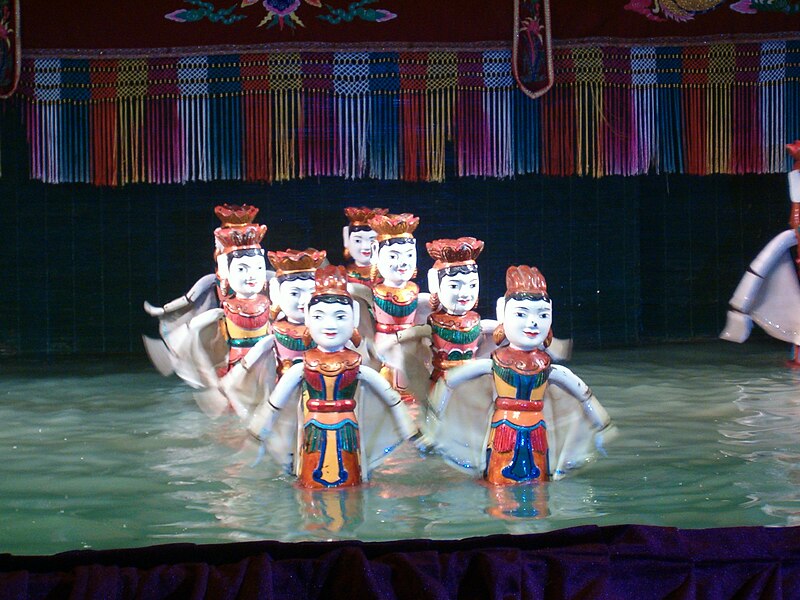
Water Puppetry originates from the rural areas of Northern Vietnam along the Red River Delta where villagers would entertain each other by putting on puppet shows during monsoon season when the rice fields were flooded. It dates back for several centuries but has only recently moved into a theatre and onto a stage. There are two main water puppet companies in Vietnam, one in Hanoi and one in Saigon. I went along to the Thang Long Theatre in Hanoi to see the show twice. The first time I saw it, I was amazed by the technique of the performers. How could they stand behind a screen and move their puppets around in front, making them jump through hoops of fire? The auditorium was a fantastic place to be, mainly because the air conditioning units blasted out cold air and reduced my body temperature down to that of a human beings.

The performances depict the day to day lives of typical rural villages including harvesting, fishing and traditional festivals. The performance takes place in a pool where the puppeteers are half submerged behind a screen and manipulate their puppets to move in front making it look as though they are walking on water. A small traditional Vietnamese orchestra accompany the action and play solo pieces including an enticing solo from the Dan Bau musician. The only thing that spoilt the enjoyable show was the amount of people taking photographs with their flash on which ruined the experience as the blast of light illuminated the puppeteers at certain points. A word of advice... If you want to take a photo in a theatre, please turn the flash off and also the stupid sound effects they make as you turn it on and take the photo!

Two days after as I had arranged to meet up with one of my mum's friends, Keith, who had been teaching English in Sihanoukville in Cambodia and was travelling up through Vietnam before he headed home. We headed to a restaurant to eat some dinner before he went to see the performance and the friends I was with were also interested in going so we all joined him. Raymond and Matt saw it as more of a gambling experience as they placed bets on the horse race. I couldn't believe how they actually followed through with the exchange of money at the end! I enjoyed the second time around too and would recommend anyone to come and see it, especially children. Maybe that's why I enjoyed it so much, I'm a big child!

Thuong Opera

For hundreds of years Thuong, or hat boi as it is known is South East Asia, has become an integral part of Vietnamese culture and many ordinary people organise shows to tell folk stories to audiences. This opera style dates back to 1285 when it was reported a Chinese performer, Ly Nguyen Cat was captured and brought to the Dai Viet court at Thang Long which is now Hanoi. It was here that he is believed to have taught Vietnamese court performers the techniques of the Zaju Chinese. The Zaju style and the Vietnamese contemporary style merged to create Thuong Opera. Further development was made when the southern songs from the Hindu kingdom of Champa which the Viets occupied. Tuong opera is reliant on stock characters. Make-up and symbolism and is performed through dance, mime, song and music played on traditional Vietnamese instruments such as the Dan Bau, perhaps my favourite instrument I have seen on my trip so far.

The Dan Bau, or Monochord in English, consists of one steel string stretched across the body which is a hardwood frame and a softwood surface One end of the string is connected to a bamboo tuning peg and the other to the handle which controls pitch and vibrato by pressing and releasing it with your left hand. To play the instrument you pluck the string with a bamboo pick held between your index finger and thumb whilst lightly resting the heel of your hand on different positions of the string to produce different harmonics. It is said that fathers would not let their daughters listen to anyone play the dan bau as it has a very romantic and emotional sound. It is usually used in Tuong Opera to accompany poems or love stories or played as a solo instrument. I first became fascinated with the instrument when I saw a lady play it at the Thang Long Theatre during the water puppet show, the sound was pure and seemed to hold tonal freedom that other instruments don't have which can evoke great emotional feelings as it's magical sound lures you into the story. I had no idea how it was played until nearly two months later on the Mekong Delta when I commandeered a musician and his dan bau and asked him to teach me to relieve my curiosity. The instrument is one of the few instruments that can be said to be of Vietnamese origin.

Tuong theatre went through a period of censorship and was eventually banned during the reign of King Le Thanh Tong from 1460-1497 due to its satirical nature. Theatrical artist were being banished from society and were prevented from any government jobs. It was reintroduced into Vietnamese society during the 1700s under the Nguyen dynasty who were fond of the art form. However, during this time Tuong went through significant changes as the special theatre agency created by the royal court commissioned Chinese actors to improve the genre seeing some conventions from Cantonese Opera being introduced. The modern Tuong Opera hit its popularity peak during the later part of the 19th century under King Tu Duc only to hit a dip during the French colonial period when Vietnamese theatre was westernised and the audiences enthusiasm for Toung diminished.

Following the end of French rule, the communist government established The Vietnam National Tuong Theatre in 1959 to promote Vietnamese theatrical heritage. The company puts on four evening, one hour performances of traditional Tuong Opera per week, one of which I attended. The performance style itself is something I respect a great deal as it doesn't rely on elaborate sets to set the scene and through symbolism encourages the audience to use their own imaginations. The stage is practically empty with maybe a chair or two and props are generally used suggestive symbols denoting where the scene is taking place and who the people are. Heavy make up is also used to characterise the performers and although I cannot tell what the differences mean, people who do can instantly tell the characters personality and social class. The actor-audience relationship is close and there is no hint of a fourth wall creating a barricade which allows interaction which helps the performance grow as the audience are forced to use their own imagination and stimulates the actors' creativity.

The style is said to have mainly remained the same although stories told do change and now include stories such as the Vietnamese fight for independence. I kind of see this as a propaganda tool for the communist government. My one question is, does censorship stunt artistic evolution? I personally cannot see how it wouldn't. Did Britain suffer from the same affect when the Theatrical Licensing Act of the late 1700s saw the Lord Chamberlain censoring every play before it was allowed to be staged? Under censorship, artists are restricted in what they can write about. They can't write about the poor, starving citizens in the countryside that struggle to make any wage, they cannot write about how their corrupt government persecute people who don't agree with their every move. Thus they are subjected to the past and to traditional performance styles. In Britain, playhouses turned to good ol' Shakespeare as the plays weren't censored and they could perform them straight off the page without any bureaucratic nonsense intervening. Edward Bond's 'Saved' (1965) is about the constant struggle of young people living on council estates with no job and no aspirations, it was refused a license by the Lord Chamberlain because of it's current social-political content and its revolting scene of a baby being stoned to death. Laurence Olivier is said to have written a letter to The Observer stating “Saved is not a play for children but for grown ups, and gown ups of this country should have the courage to look at it.”.

The Royal Court Theatre went against the Lord Chamberlain's decision and performed the play to 'private' audiences. The Lord Chamberlain was outraged and decided to sue all perpetrators responsible with staging the play. This was a great moment for British theatre as it the public were in turn outraged and the Theatrical Licensing act was finally and thankfully abolished in 1968. Theatre has the power to make people think. Places like China and Vietnam do not want their citizens to think, it doesn't adhere to Hu Jintao's 'harmonious development of society' where he wants his people to just fit in with their ideals and work like a machine without discussion. If playwrights were given the the freedom to write and perform texts about contemporary issues like Bond's Saved, would their style become more dramatic, more psychological and naturalistic? Having said this, Russia had been under censorship for centuries before Stanislavski created his system that altered the way actors perform worldwide. A question which I will look into is, why hasn't their theatre developed? Is it a censorship issue?

Ho Chi Minh and his Vietnamese Vision

Uncle Ho
This 'wonderful' icon of the Vietnamese people was born 19 May 1890 in a Vietnam that was under heavy French colonialism. His life took him around the world working in USA, England, France, Russia and China until he returned to Vietnam as leader of the Viet Minh independence movement. After many years of fighting he became the leader of the country until his death in 1969. There is a general image of him being one of the nice communist leaders, with photos of him working in the fields during the war effort but he was just like the others. It is reported that hundreds of thousands of people were killed in re-education camps, forced labour camps and political executions after the Vietnamese war. A trick he must have learnt from his time in Russia and China. Despite this, he is still a marked hero to the Vietnamese people with his photo hung everywhere and Saigon was renamed after him.

On Raymond's last day before he headed off to Laos, we went to visit Ho Chi Minh's Mausoleum. Having not visited Lenin's mausoleum in Moscow or Mao's mausoleum in Beijing, I thought I should take this opportunity to see one of the three famous communist dictators. We approached the mausoleum and immediately discovered that we had entered from the wrong direction as I soldier promptly waved us away as we tried to walk across the grass in front. We ended up having to walk around the huge grass area in front of the tomb and then around a block of buildings before finally finding the entrance to the mausoleum and museum. There was no queue, which I was thankful for as I wasn't in the mood to be waiting around for ages to see Uncle Ho, as he is commonly referred to. We had to wait for a few minutes for a few more people to join the group before we followed a soldier dressed in an immaculate white uniform in a line two people wide around the complex and into the cold temperature inside of the mausoleum. The entrance to the resting place of Uncle Ho is grand, the marble walls help maintain the temperature at the constant level required to keep the body in good condition. Soldiers stand on guard at the door with their automatic rifles gripped in both hands. There are strict rules that you need to abide by when visiting, you must not take a camera in with you, must not have a mobile phone on and must be dressed appropriately. As we entered the room where Ho Chi Minh lays, a man's telephone rings and the Vietnamese being the people they are have their ring tones on the loudest setting possible to disturb as many people as they can. The soldier promptly pulled him aside and gave him a stern talking to.

I personally have never seen the fascination to see embalmed people as you could go to Madame Tusauds for that. My main issue with Ho Chi Minh being embalmed is that they spend millions and millions of dollars sending him to Russia every year to get treated and to keep him in state when at the same time Vietnamese people are struggling to survive on the very little money they have. Ho Chi Ming also specifically stated that he wanted to be cremated as he didn't want to take up space that people need to live. So not only are they spending money their citizens need to live, they are going against the wishes of their country's founding father. Utterly disgusting! Alongside the Mausoleum is the Ho Chi Minh museum which is one big museum full of communist propaganda showing photos of Ho doing 'good' in the community, meet his 'fans' etc. There was, of course, no mention of the thousands of people he killed or the many oppressed Vietnamese people.

During my time in Hanoi, Raymond and I made a friend with a man who drives round on his motorbike selling books. Gene rides around on his motorbike from 8am to 10pm selling copied books to tourists and anyone that wants one. As we were sitting outside a restaurant on a busy street corner, Gene pulled up in front of us and asked us whether we wanted to buy a book from him, we told him that we didn't which eventually made him move on. Every fifteen minutes Gene repeated the process however instead of books he went on to marijuana and then onto ladies and 'boom boom'. After an hour, he finally gave up trying to sell us things and started to talk with us like human beings. We got on and invited him for a drink when he finished work, an invitation he accepted and once he had dropped his books off, he joined us for a couple of beers. This happened a couple of nights and we got to know quite a bit about him.

Gene has a wife, young child and a new born baby. He works for twenty-eight days of the month and is only able to return to his village and see his family for three days a month. On a good day he earns only 120,000VND (just under £3.50) a day from selling his books which works out as 840,000VND per week (£24.50). His baby alone costs him around 1,000,000VND (£30) per week. That's already a shortfall in income. He tries to make up some more money by selling marijuana, acting as a moto-taxi, getting customers for 'boom-boom' and laundry, basically anything you can think off he'll help you out for a small fee. We didn't give him any money but supplied him with a few beers each evening we saw him, in return when he saw us he would take us on the back of his bike anywhere we wanted to go. One evening he took us back to our hotel which was quite concerning as he had drank two beers and there were three of us on his bike weaving in the road whilst singing a random version of 'Rivers of Babylon'. He was an extremely friendly man, as are the majority of Vietnamese, and I have utmost respect for his persistence in work to support his family. He was also taking English lessons to improve his chances of getting a better paid job, but as this costs money he can only take a couple of lessons per month, if that.

It was time to say goodbye to Raymond as he got on a bus heading into Laos, this would be the last time I would meet him on my trip we thought we may meet each other again in Saigon but I left two weeks before he got there. Another Dutch man had moved into our room, Niek, a photographer working on a project in Hanoi for a month or so. We spent the next few days relaxing in café's drinking Vietnamese coffee and him showing me around parts of town I hadn't seen whilst he found the elderly Hanoi population and convinced them to take a photo of them. It was a fascinating process to witness, I have always wondered how you go about taking photos of individuals when you can't speak their language but with gestures and a lot of persistent persuasion, Niek managed to get some fantastic photographs for his project. I will add his website link up on here when it becomes live in May sometime.

I liked Hanoi, I spent over two weeks there wondering the bustling streets, savouring the delicious food and drink but it was time to move on. Hanoi is crazy but has a feeling of calm, perhaps it's because I had just come from China and anywhere is calmer than China! You could easily spend a lot longer there just roaming the streets and browsing the many shops and stalls that line the streets. 

Next time, Into the Hills, Sapa!